

Curbside Consult
The AI got better. The decision got harder.
September 8, 2026 · By Jeff Willis, MD
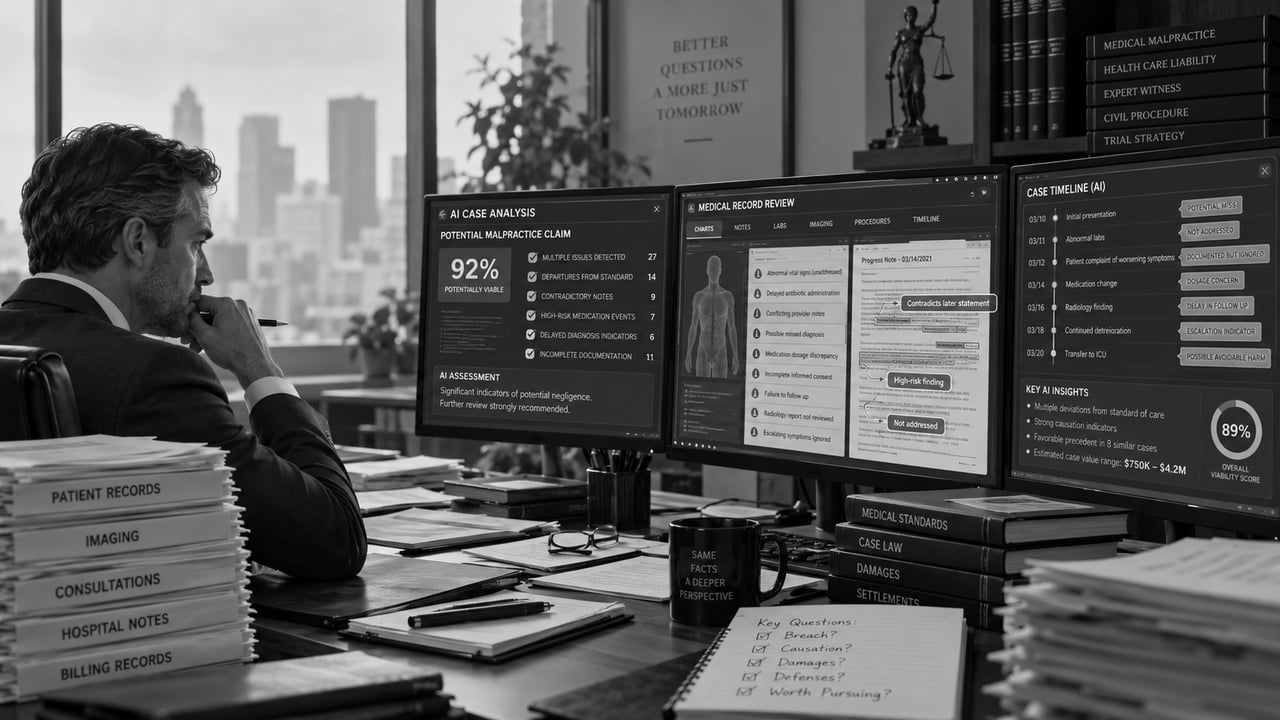
It's crazy how much has changed in medical malpractice pre-litigation over the last three years.
When I started working with attorneys, analyzing a potential case meant a stack of paper. Some attorneys did it themselves. Some had in-house nurses. Some called physicians like me.
Now almost every attorney has AI software that does the first pass faster and cheaper than any of us ever could.
When the platforms started coming out, I tried them all.
The result?
Terrible. Just terrible.
Twelve months ago the output was useless... or worse, dangerous. Wrong medicine. Missed data. Irrelevant findings pushed to the top. Every company was more worried about being first than being right.
That was twelve months ago.
Today is different. Extraction is better. Analysis is better. The interface is better. Cost... still up in the air.
And here's the part I didn't see coming.
The better the software got, the harder the decision got.
I do pre-litigation analysis and expert sourcing for plaintiff firms, so I see a lot of these reports. More and more they show up attached to the case itself. The note usually reads something like this: "Please review this and let me know if there's a case. I've attached our AI analysis, FWIW."
FWIW is doing a lot of work in that sentence.
The reports aren't wrong anymore. They're thorough. Twenty pages, every deviation flagged, nothing missed. And the attorney is left looking at six directions the case could go... one or two of which will ever amount to anything. If that.
Here's what that looks like.
Delayed head CT. Incomplete medication reconciliation at admission. A neurology consult that was ordered and never documented. A four-hour gap in nursing neuro checks. Four flags, all accurate, all real deviations from what should have happened.
Three of them are noise.
The nursing gap and the med rec didn't change anything about this patient's outcome. The missing consult note is a documentation problem, not a care problem, and defense counsel will produce the consultant to say so. The delayed CT is the case... but only because of when the symptoms started and what the first set of vitals showed. Move that timeline by ninety minutes and it's the med rec that matters and the CT is noise.
Nothing in the report tells you that. It can't. Ranking those findings means deciding which deviation actually caused this harm, to this patient, with this documentation, in this clinical context. That's a medical judgment. It isn't a retrieval problem, and a better model doesn't solve it.
So it gets sorted out case by case. Sometimes the analysis is bad enough that we start over. Sometimes we glance at it and go straight to expert retention. Sometimes we decide there's no case at all, whatever the report says.
I still don't run my own reviews through a platform. I use the big language models every day, but the record review is manual. It's the only way I can be certain I've seen every piece of information in the right context. There will be a day when that changes. It's not here.
If you've got one of these reports sitting in a folder, send it over and let's talk through it. Twenty minutes, no charge, no obligation. I do this because it's the fastest way for both of us to find out whether we'd work well together, and because I'd rather look at a real case than explain what I do in the abstract.